
Wall removal & knock-throughs
Chimney breast removal
Remove a chimney breast to gain floor space, with anything left above supported to the engineer's design.
- Free survey visit and itemised written quote
- Calculations and building control arranged
- 2–4 working days for a ground-floor breast with support; longer where the stack and roof work are included
- Free survey visit
- Engineer's calculations arranged
- Building control handled
- Fixed written price once scope is agreed
- England, Wales, mainland Scotland & NI
What is chimney breast removal?
Chimney breast removal is taking out the projecting brickwork that houses the flues from fireplaces, usually to gain floor space or straighten a wall. If any of the breast or stack above stays in place, it must be carried on steel or another support the engineer designs and building control accepts, so it is never left unsupported.
Chimney breasts take up a surprising amount of room, especially in the kitchens and bedrooms of older terraces and semis. Removing one is common, but it is structural work: the breast usually continues upstairs and up through the roof, and in terraces the stack is often shared with the house next door.
We cover the survey visit, structural calculations from a qualified engineer, building control, party wall notices through a party wall surveyor where needed, temporary support, removal, the steelwork and making good. Whether you are taking out the ground-floor breast only or the full height, the itemised written quote shows each stage.
When is it needed?
- Gaining floor space in a kitchen, living room or bedroom
- Making room for a kitchen run, wardrobe or fitted furniture
- Straightening a wall as part of a knock-through or refit
- Clearing an unused chimney out of a loft conversion
- Taking out a breast that is damp, cracked or no longer needed
- Timing
- 2–4 working days for a ground-floor breast with support; longer where the stack and roof work are included
- Building control
- Needed
- Party wall
- Often needed (E&W)
- Guide price
- £1,500–£3,000

Our process
How is chimney breast removal carried out?
Chimney survey
We check every floor and the loft to see how far the breast runs, whether the flue is still in use, how the stack sits on the roof and whether it is shared with a neighbour. Damp staining and cracking are noted.
Support design
The structural engineer decides how any remaining breast or stack is carried, often on a steel beam bearing onto suitable walls. Building control has the final say on whether a lighter method such as gallows brackets is acceptable.
Notices and flue checks
Building control is applied to or notified, and party wall notices are arranged where the breast is on a shared wall in England or Wales. Any gas fire or boiler flue using the chimney is disconnected by a Gas Safe registered engineer first.
Supporting what stays
Where a breast above is being kept, its new support goes in before the brickwork below is taken out. Temporary props hold the masonry while the steel is inserted, bedded and packed tight.
Breast taken out
The brickwork is removed course by course, with heavy dust sheeting because chimneys hold a lot of soot. Debris is bagged and carried out, and the hearth is broken out down to floor level.
Venting, capping and making good
The wall is plastered flat and the floor is filled where the hearth was. Where the stack stays, unused flues are capped and ventilated; where it comes down, the roof is felted and tiled over.
Before you start
What should I know about chimney breast removal?
- Removing only the ground-floor breast leaves the upper breast and stack in place, so they must be supported. Taking the breast out on every floor and removing the stack above the roof avoids that load entirely, but involves roofing work and more disruption.
- Gallows brackets are steel angle brackets fixed into the wall to hold a breast above. They are often not accepted where the remaining masonry is heavy or sits against the neighbour's breast, so the engineer and building control decide which support method is suitable.
- In terraces and semis the chimney stack usually serves both houses, with flues from each side rising together. You can generally only alter your own side, and the work must not weaken your neighbour's breast or flues, which is why party wall procedures often apply.
- In England and Wales, cutting away a chimney breast attached to a party wall is notifiable work under the Party Wall etc. Act 1996. Notice must be served on the neighbour before work begins, and their response decides whether party wall surveyors need to be appointed.
- A flue still serving a gas fire, boiler or wood burner cannot be removed until that appliance is disconnected and an alternative arranged. Work on any gas appliance or pipe must, by law, be done by a Gas Safe registered engineer.
- A chimney closed off at both ends can trap moisture and cause damp patches on the walls. Where part of a flue remains, a vent at room level and a ventilated cap on the pot keep air moving through it.
- Chimney brickwork is heavy and dirty. Even a single breast produces a lot of rubble and soot, so a skip or waste collection is planned in advance, and floors, stairs and furniture along the route out are protected.
- If you remove the breast in a ground-floor room but want to keep a fireplace or the breast in the bedroom above, the steel underneath must be designed for that load. Its ends need solid bearings, which may mean pockets cut into the party wall.
- Some owners remove breasts in the loft to make space for a conversion while keeping the stack on the roof. That leaves the stack carried at loft level on steel or another support, which the engineer must design and building control must approve before work starts.
- Older fireplaces sometimes contain asbestos in flue linings, fire surrounds, hearth boards or heat-resistant panels. In buildings from before 2000, suspect materials are identified with a survey before removal so they can be handled correctly.
- Removing a ground-floor breast with steel support typically takes two to four working days. Full-height removal including the stack and roof repair takes longer and depends on scaffolding, roofing access and the weather.
- Once the breast is gone, the wall behind it is often rough, sooty or uneven. It is cleaned back, dubbed out where needed and plastered flat, and the floor where the hearth sat is filled level to meet the surrounding boards or screed.
- The price depends on how many floors the breast spans, whether the stack is kept or removed, the support method the engineer specifies, roof and scaffold work, and how much rubble needs taking away. Each is listed separately in the quote.
- A chimney breast removed without proper support or approval is a frequent issue raised in surveys when a house is sold. Keeping the calculations, completion certificate and any party wall documents shows a buyer that what remains was properly supported.
Costs
How much does chimney breast removal cost?
| Job | Typical guide range | What it usually covers |
|---|---|---|
| Chimney breast removal (ground floor) | £1,500–£3,000 | Ground-floor breast removed, steel to support the breast above, building control and making good |
| Chimney breast removal (whole breast) | £2,500–£5,000 | Breast removed on both floors with stack support or removal, scaffold where needed, approvals and making good |
| Structural calculations for a beam | £250–£750 | Site measure or photos, beam and padstone design and calculations for building control |
| Building control fees | £250–£650 | Building notice or full plans fee and inspections; varies by council or approver |
Rounded guide ranges including VAT, from published UK cost guides (mainly 2024–2026) and our own costings. Your fixed price follows a survey and the engineer's calculations. Sources and notes.
What changes the price?
- Number of floors the breast runs through
- Whether the stack is kept and supported or taken down
- Support method specified by the engineer
- Scaffolding and roof repairs for stack removal
- Party wall notices where the breast is on a shared wall
- Waste removal, venting, plastering and floor making good
Approvals
What approvals does chimney breast removal need in each nation?
Chimney breast removal is structural work needing building regulations approval (building notice or full plans) from council building control or a registered building control approver. Party wall notices may be needed where steel bears into a shared wall.
England rulesApproval under the Building Regulations as they apply in Wales is needed before work starts. For work started or approved from 1 July 2026 that means an application to the council or a registered building control approver, dutyholders appointed in writing and a commencement notice. The Party Wall etc. Act 1996 applies in Wales too.
Wales rulesA building warrant from the council's building standards service must be granted before work starts, and a completion certificate submitted at the end. There is no Party Wall Act; title deeds and, for flats, the Tenements (Scotland) Act 2004 apply.
Scotland rulesA full plans application or building notice goes to the council's building control under the Building Regulations (Northern Ireland) 2012 before work begins. Northern Ireland has no Party Wall Act; title deeds and the general law apply.
Northern Ireland rulesChimney breast removal questions
Can I remove a chimney breast on the ground floor only?
Yes, but whatever stays above must be properly supported. The structural engineer designs that support, usually a steel beam bearing onto walls that can take the load, and building control must approve it before work starts. Leaving an upper breast or stack without adequate support is dangerous and is a problem surveyors look for.
Do I need building regulations to remove a chimney breast?
Yes. Removing all or part of a chimney breast is structural work. In England it needs building regulations approval through a full plans application or building notice, and in Wales an application under the Welsh regulations; in Scotland a building warrant is needed before starting; in Northern Ireland an application goes to council building control. We prepare and submit this with the engineer's calculations.
Are gallows brackets allowed for chimney breast support?
Sometimes, but not always. Gallows brackets are used for lighter loads in certain situations, yet many building control bodies will not accept them where the remaining breast is heavy, sits on a party wall or carries the neighbour's flues. The structural engineer proposes a method and building control decides whether it is acceptable.
Do I need my neighbour's permission to remove a chimney breast?
Not permission as such, but in England and Wales you must serve notice under the Party Wall etc. Act 1996 if the breast is attached to a party wall, and your neighbour can consent or dissent. You cannot remove their half of a shared stack. Scotland and Northern Ireland have no equivalent Act, so the title deeds and general law apply.
Should I remove the chimney stack as well?
It often makes sense if the breast is coming out on every floor, because then nothing is left to support. It needs scaffolding and roof repairs, and in terraces the stack is often shared, so your side may not be removable without affecting your neighbour's. The engineer and building control confirm what is possible.
How long does chimney breast removal take?
A ground-floor breast with a steel beam supporting the masonry above usually takes two to four working days, including propping, fitting the steel, removing the brickwork and basic making good. Full removal from ground floor to roof takes longer because of scaffolding, roofing work and weather, and plaster needs time to dry afterwards.
What if my chimney breast was removed without support?
Get it checked by a structural engineer as soon as possible. If the upper breast or stack has no adequate support, it may need propping straight away. A support can usually be fitted retrospectively, and in England and Wales a regularisation application to the local authority can be used to get the unauthorised work approved.
Will removing a chimney breast cause damp?
It can if the remaining flue is sealed with no airflow, because moisture and condensation get trapped inside. Fitting a vent in the remaining breast or wall and a ventilated cap on the chimney pot keeps air moving. If the stack is removed and the roof made good, the risk from the flue goes away.
Can I remove a chimney breast downstairs and keep the fireplace upstairs?
Usually, as long as the upstairs breast and its flue stay intact and are carried on a support the engineer designs for that load. Building control must approve the arrangement. If the upstairs fireplace has a gas fire, any work on it or its supply must be carried out by a Gas Safe registered engineer.
What is included in a chimney breast removal quote?
The itemised written quote covers the survey, engineer's calculations, building control, any party wall notices, temporary support, the steel or other support specified, removal and waste, venting or capping, and plastering and floor making good. Scaffolding and roof work appear as separate lines where the stack is involved, and the price is fixed in writing once the scope is agreed.
Related services
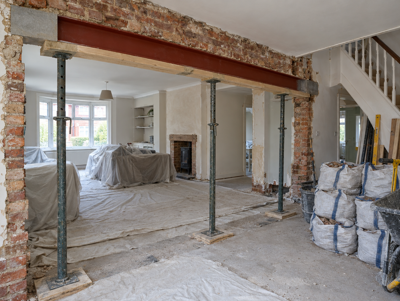
Load-bearing wall removal
Take out a structural wall and carry the load on a new steel beam, with calculations and sign-off arranged.
From £2,000Learn more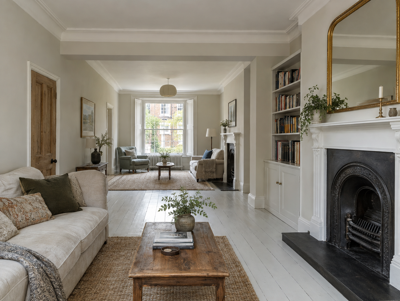
Through-lounge knock-throughs
Join front and back reception rooms into one through-lounge, with steel, approvals and period finishes handled.
From £2,500Learn more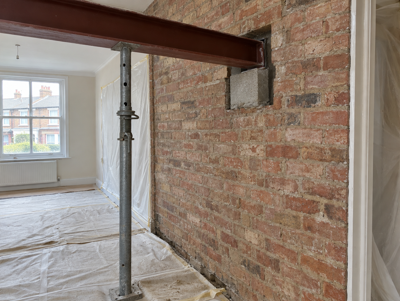
Party wall beam works
Beams bearing into a shared wall, with party wall notices arranged through a surveyor before work starts.
Surveyor from £900 per neighbourLearn more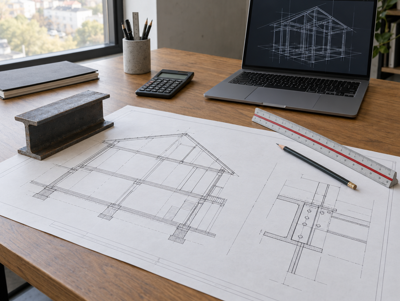
Structural calculations
Engineer's calculations and drawings for your beam, padstones and propping, ready for building control.
From £250Learn more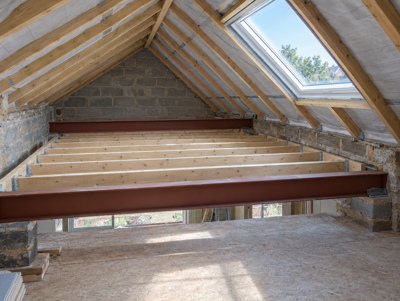
Loft conversion steels
Steel beams to carry a new loft floor, dormer and roof loads, designed, lifted in and bedded on padstones.
From £2,500Learn more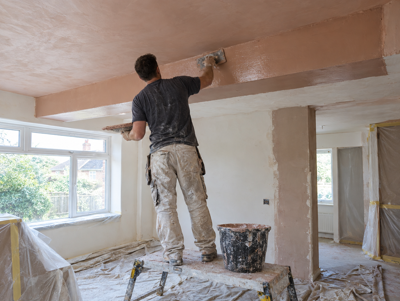
Plastering & making good
Box, bead and skim new steelwork and repair ceilings, walls and floors so rooms are ready to decorate.
From £300Learn moreWhere do we offer chimney breast removal?
Choose your county, council area or region for local details, building control contacts and guide prices.
England
- Bedfordshire
- Berkshire
- Bristol
- Buckinghamshire
- Cambridgeshire
- Cheshire
- Cornwall
- County Durham
- Cumbria
- Derbyshire
- Devon
- Dorset
- East Riding of Yorkshire
- East Sussex
- Essex
- Gloucestershire
- Greater Manchester
- Hampshire
- Herefordshire
- Hertfordshire
- Isle of Wight
- Kent
- Lancashire
- Leicestershire
- Lincolnshire
- London
- Merseyside
- Norfolk
- North Yorkshire
- Northamptonshire
- Northumberland
- Nottinghamshire
- Oxfordshire
- Rutland
- Shropshire
- Somerset
- South Yorkshire
- Staffordshire
- Suffolk
- Surrey
- Tyne and Wear
- Warwickshire
- West Midlands
- West Sussex
- West Yorkshire
- Wiltshire
- Worcestershire
Wales
- Anglesey
- Blaenau Gwent
- Bridgend
- Caerphilly
- Cardiff
- Carmarthenshire
- Ceredigion
- Conwy
- Denbighshire
- Flintshire
- Gwynedd
- Merthyr Tydfil
- Monmouthshire
- Neath Port Talbot
- Newport
- Pembrokeshire
- Powys
- Rhondda Cynon Taf
- Swansea
- Torfaen
- Vale of Glamorgan
- Wrexham
Scotland
- Aberdeen
- Aberdeenshire
- Angus
- Argyll and Bute
- Clackmannanshire
- Dumfries and Galloway
- Dundee
- East Ayrshire
- East Dunbartonshire
- East Lothian
- East Renfrewshire
- Edinburgh
- Falkirk
- Fife
- Glasgow
- Highlands
- Inverclyde
- Midlothian
- Moray
- North Ayrshire
- North Lanarkshire
- Perth and Kinross
- Renfrewshire
- Scottish Borders
- South Ayrshire
- South Lanarkshire
- Stirling
- West Dunbartonshire
- West Lothian
Northern Ireland