Fire protection for steel beams · East Kilbride
Fire protection for steel beams in East Kilbride
Fire protection for steel beams in East Kilbride, from free survey to completion certificate.
- Itemised written quote
- Beam sized by a structural engineer
- Covering East Kilbride and nearby
- Free survey visit
- Engineer's calculations arranged
- Building control handled
- Fixed written price once scope is agreed
- England, Wales, mainland Scotland & NI
Fire protection for steel beams in East Kilbride: how it works
For homes in East Kilbride and the G74 district, we handle fire protection for steel beams from survey to sign-off. We also cover the surrounding towns and villages in South Lanarkshire. The beam is sized by a structural engineer and inspected before it is boxed in.
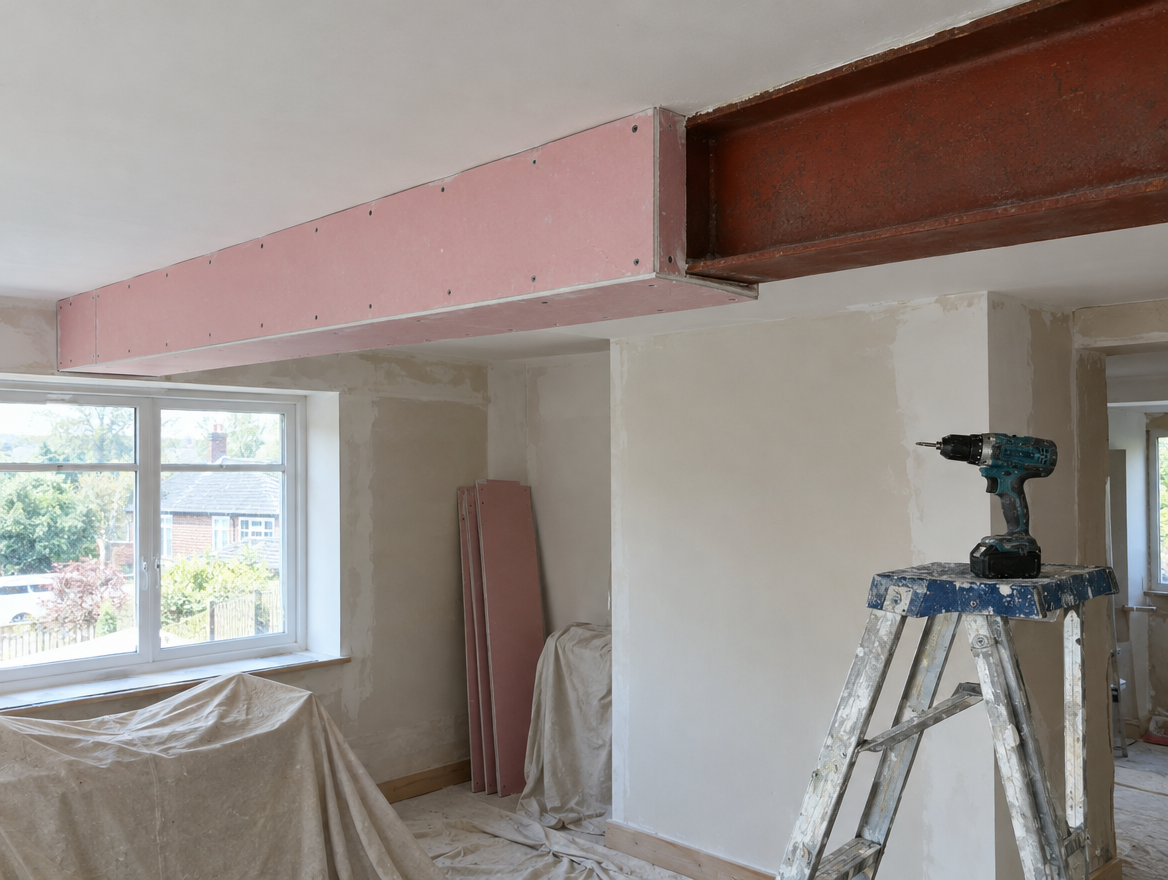
A bare steel beam is strong at room temperature but loses much of its load-carrying capacity once it gets hot enough in a fire. If that beam holds up a floor or the walls above, it matters to everyone in the building. Fire protection slows the rate at which the steel heats up, buying time for people to get out safely.
Key points for your project
- Boxing is generally the lower-cost route for steel that will be hidden. Intumescent coatings cost more because of the product and the number of coats, and the price rises with the fire period and the size of the section.
- Fire boarding should not be cut into casually later on. Downlights, cables and pipes pushed through the boxing can weaken it, so services are planned before boarding, and any openings are sealed with suitable fire-stopping materials.
- Older homes sometimes have steel fitted decades ago with no protection at all, or boxed in ordinary timber and hardboard. When this turns up during other work, we can check what is there and price protection to suit today's requirements.
- A common fault is applying intumescent paint over the wrong primer, or over one of unknown type. The products must be compatible, so where steel was primed long ago the primer is identified or the surface is cleaned back before coating.
- The fire resistance needed depends on the building and where the steel sits. In a typical two-storey house, elements of structure commonly need 30 minutes, but taller homes, flats and commercial premises can need more. The engineer and building standards confirm the figure.
What happens, step by step
Look and measure
We check the wall, the span you want and what the wall is carrying, and photograph anything the engineer needs to see.
Design and price
Calculations come back from the engineer and we confirm your fixed written price, line by line.
Building warrant
A building warrant is applied for from South Lanarkshire Council, and work starts only once the warrant has been granted.
Fit, inspect, finish
The work is propped and the steel installed and packed tight. After inspection the opening is boxed, plastered and left clean.
Guide prices for fire protection for steel beams in East Kilbride
As a guide, budget £140–£550 per beam including VAT for fire protection to a steel beam in East Kilbride, based on published UK cost guides adjusted for prices in Scotland (-9%).
| Job | Typical guide range | What it usually covers |
|---|---|---|
| Fire protection to a steel beam | £140–£550 per beam | Fire-rated board boxing or an intumescent coating system as specified |
| Steel beam replacement | £1,800–£5,000 | Propping, removing the failed beam, new steel on proper bearings, approval and making good |
| Steel column or post | £460–£1,360 per column | Column supplied and fitted with base and cap plates on a pad foundation |
| RSJ supply and fit (single beam) | £730–£2,280 per beam | Beam supplied, delivered, lifted and packed on padstones, with propping (calculations and approval priced separately) |
Figures include our approximate regional adjustment for prices in Scotland (-9%) and are rounded. How these figures are worked out.
Building control and neighbours in East Kilbride
In Scotland, structural alterations need a building warrant under the Building (Scotland) Act 2003, and work must not start until the warrant is granted. For East Kilbride, warrants are handled by South Lanarkshire Council's building standards service. When the work is finished, a completion certificate is submitted and has to be accepted by the council.
There is no party wall notice system in Scotland. Instead, check your title deeds and, for flats, the tenement management scheme, and talk to neighbours early if the beam bears into a shared wall.
Fire protection for steel beams near East Kilbride
- Cambuslang 3.2 mi
- High Blantyre 3.3 mi
- Blantyre 3.9 mi
- Rutherglen 4.7 mi
- Hamilton 5.6 mi
- Meikle Earnock 5.7 mi
Local questions answered
Can you work on older or listed homes in East Kilbride?
Yes. Older homes often have lime mortar, timber lintels or shallow footings, which the engineer allows for. Listed buildings need listed building consent for internal structural changes as well as building regulations approval, and that must be in place first.
Do you also work near East Kilbride?
Yes. We also cover nearby towns including Cambuslang, High Blantyre, Blantyre and Rutherglen.
How long does intumescent paint take to apply?
Several days in most cases. Each coat has to dry before the next is applied, and the number of coats depends on the thickness needed. Cold or damp rooms slow drying, so the space is kept warm and ventilated, and the top coat goes on once the full build has been measured.
What is intumescent paint for steel beams?
Intumescent paint is a fire-protective coating that swells when heated, forming a thick insulating layer that slows the steel heating up. It lets you leave a beam on show while still meeting fire requirements. It must be applied at a specified thickness over a compatible primer, so it goes on to a written specification rather than like ordinary paint.
How thick does intumescent paint need to be on a steel beam?
There is no single figure. The thickness depends on the steel section, how many sides are exposed and the fire period required, and the coating manufacturer's data sets the dry film thickness for each case. The applied thickness is measured with a gauge once the coats have dried and recorded for building standards.