Fire protection for steel beams · Cumbria
Fire protection for steel beams in Cumbria
Calculations, approvals, propping, steel and making good for fire protection for steel beams across Cumbria.
- Survey, design and installation in one
- Covering CA1, CA10, CA11, CA12
- Inspected before it is covered
- Free survey visit
- Engineer's calculations arranged
- Building control handled
- Fixed written price once scope is agreed
- England, Wales, mainland Scotland & NI
About our fire protection for steel beams service in Cumbria
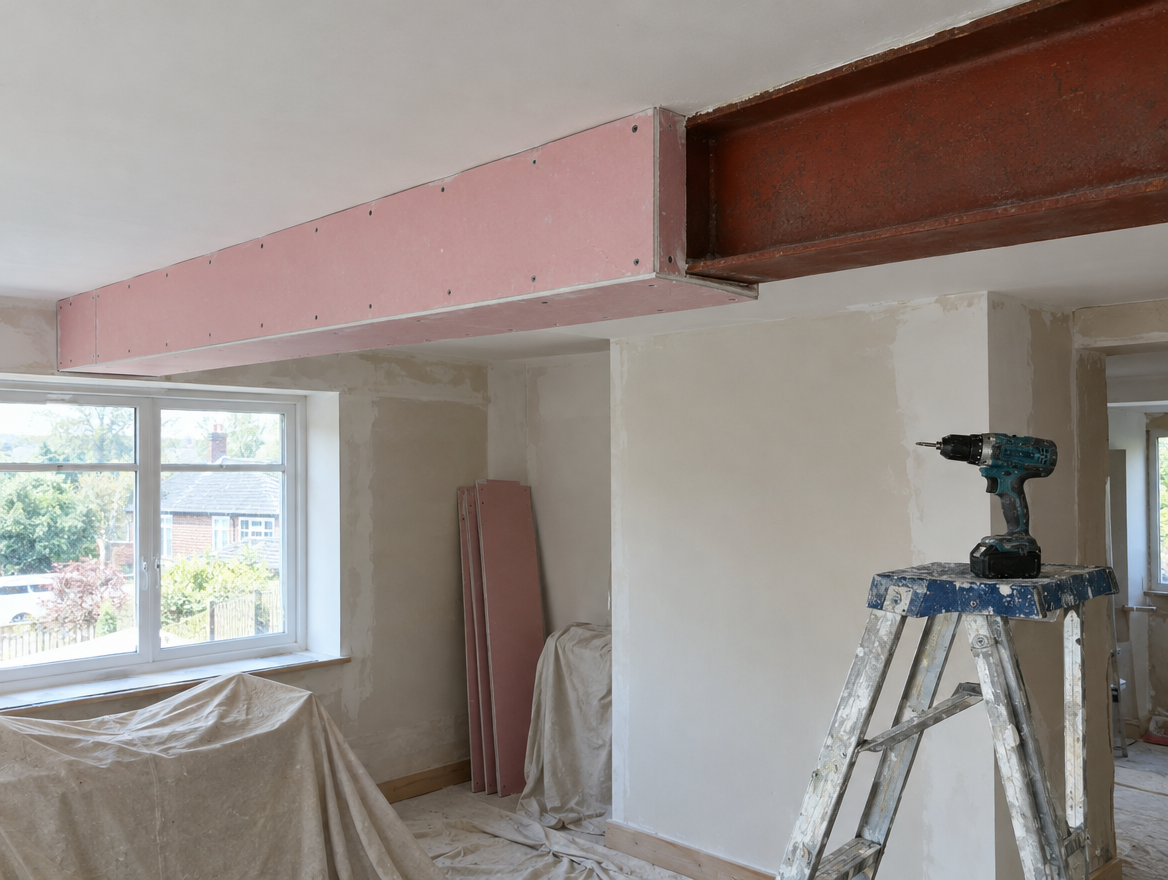
Fire protection for steel beams is the layer of fire-rated board or intumescent coating applied to structural steel so it keeps its strength long enough in a fire for people to get out. Steel softens as it heats, so building regulations set a period of fire resistance for beams and columns, and the protection is chosen and applied to meet that period.
Across Cumbria, fire protection for steel beams usually comes up when people want more light, a better layout or a way through to a new extension. That includes Workington, Carlisle and Kendal, plus smaller towns and villages nearby. Whatever the reason, the beam is sized from calculations and the work is inspected before anything is covered.
Worth knowing before you start
- Intumescent paint looks like an ordinary coating but swells into a thick insulating char when heated. How well it performs depends on the dry film thickness, which varies with the steel section and fire period, so it is applied to a written specification.
- Fire boarding should not be cut into casually later on. Downlights, cables and pipes pushed through the boxing can weaken it, so services are planned before boarding, and any openings are sealed with suitable fire-stopping materials.
- Older homes sometimes have steel fitted decades ago with no protection at all, or boxed in ordinary timber and hardboard. When this turns up during other work, we can check what is there and price protection to suit today's requirements.
- Boxing is generally the lower-cost route for steel that will be hidden. Intumescent coatings cost more because of the product and the number of coats, and the price rises with the fire period and the size of the section.
- Exposed steel is popular in open-plan kitchens and loft spaces. An intumescent system can take a decorative top coat in most colours, although up close the finish has a slightly textured look compared with steel painted in a factory.
How the job runs in Cumbria
Free visit
A short visit to Cumbria to see the job, agree what you want and check the bearings, floors and services that affect the design.
Calculations
The engineer's calculations and a simple drawing are prepared for your opening and shared with you before anything is ordered.
Building control
We submit a building notice or full plans application to the local council's building control team, so approval is in place before the wall is touched.
Steel in, made good
On site we prop, open up, fit and pack the steel, then fire protect, box in and plaster once the inspection is done.
How much should I budget in Cumbria?
As a guide, budget £140–£580 per beam including VAT for fire protection to a steel beam in Cumbria, based on published UK cost guides adjusted for prices in the North West (-4%).
| Job | Typical guide range | What it usually covers |
|---|---|---|
| Fire protection to a steel beam | £140–£580 per beam | Fire-rated board boxing or an intumescent coating system as specified |
| Building control fees | £240–£620 | Building notice or full plans fee and inspections; varies by council or approver |
| Steel column or post | £480–£1,440 per column | Column supplied and fitted with base and cap plates on a pad foundation |
| RSJ supply and fit (single beam) | £770–£2,400 per beam | Beam supplied, delivered, lifted and packed on padstones, with propping (calculations and approval priced separately) |
Figures include our approximate regional adjustment for prices in the North West (-4%) and are rounded. How these figures are worked out.
Building rules for Cumbria
For Cumbria, building control is provided by the local council's building control team, or by a registered building control approver if preferred. We send them the engineer's calculations with a building notice or full plans application and book the inspections. Work done without approval can cause problems at sale and is far dearer to put right later.
Terraced and semi-detached homes often need party wall notices, because cutting into a shared wall to take a beam end is notifiable under the Party Wall etc. Act 1996. Allow at least two months for the notice period unless your neighbour agrees sooner.
Fire protection for steel beams by town
Questions about fire protection for steel beams in Cumbria
Do you cover Cumbria for fire protection for steel beams?
Yes. We carry out fire protection for steel beams in Cumbria. Book a free survey visit and we will check the wall, arrange the engineer's calculations and send an itemised written quote.
What happens at the survey visit in Cumbria?
We look at the wall, the floor and ceiling either side and what sits above, measure the opening you want, and note cables, pipes and access for the steel. It usually takes under an hour and there is no charge.
Can I box in a steel beam with normal plasterboard?
Not where fire protection is required. Standard plasterboard is not designed to protect steel for a set period in a fire. Fire-rated plasterboard is used instead, fixed in the number of layers and with the fixings the system specifies, so the boxing performs as intended and passes when building control checks it.
Can I put downlights in a boxed-in steel beam?
Only with planning. Cutting holes in fire boarding can weaken its protection, so any lights in or near the boxing need to be designed in, using fire-rated fittings or suitable fire-stopping where the board is pierced. It is far easier to sort this out before the boxing goes up than to adapt it afterwards.
Does a steel column need fire protection as well as the beam?
Usually, if the column is part of the load path. A column carrying a beam is just as important in a fire, so it normally needs the same fire resistance. Columns are often boxed with board or coated with intumescent paint, and the engineer's design and building control confirm what applies to yours.
How long does intumescent paint take to apply?
Several days in most cases. Each coat has to dry before the next is applied, and the number of coats depends on the thickness needed. Cold or damp rooms slow drying, so the space is kept warm and ventilated, and the top coat goes on once the full build has been measured.
Can you work on older or listed homes in Cumbria?
Yes. Older homes often have lime mortar, timber lintels or shallow footings, which the engineer allows for. Listed buildings need listed building consent for internal structural changes as well as building regulations approval, and that must be in place first.