A party wall notice is formal notice served on a neighbour before certain work to a shared wall. In England and Wales, the Party Wall etc. Act 1996 covers cutting into a shared wall to seat the end of a beam, and a party structure notice must reach the neighbour at least two months before work begins. The Act does not apply in Scotland or Northern Ireland.
When does a steel beam need a party wall notice?
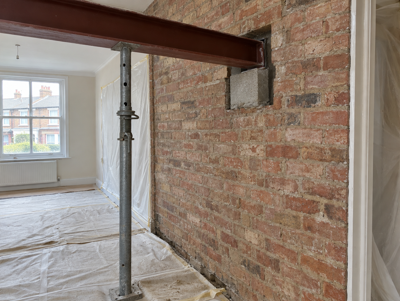
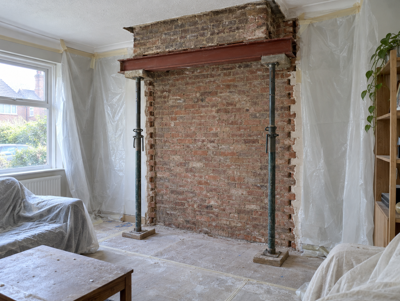
The Party Wall etc. Act 1996 gives a building owner the right to cut into a party structure for any purpose, and the government's explanatory booklet uses cutting into a party wall to take the bearing of a beam as its example. The same section covers cutting away a projecting chimney breast. Exercising those rights means serving notice on the adjoining owner first.
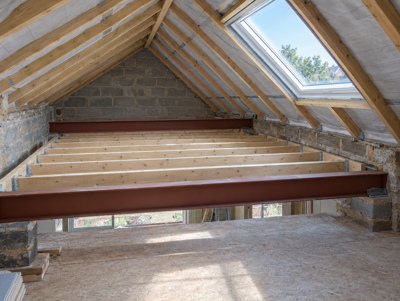
Steel beam jobs that commonly involve a party wall include through-lounge and kitchen-diner knock-throughs in terraced and semi-detached homes, loft conversion steels bearing on the separating wall, chimney breast removals and side return extensions. Where a beam bears only on your own walls, the Act may not be involved for the steel itself, although digging near a neighbour's foundations can bring in a separate notice.
Which notices apply and how much warning is needed?
Different work triggers different notices, each with its own minimum period. The table covers the three most relevant to steel beam projects.
| Notice | When it is used | Minimum warning |
|---|---|---|
| Party structure notice | Work to a party wall, such as cutting in for a beam bearing or removing an attached chimney breast | At least two months |
| Line of junction notice | Building a new wall on or at the boundary line | At least one month |
| Adjacent excavation notice | Excavating near a neighbour's building, which can include pad foundations close to the boundary | At least one month |
A party structure notice lapses if the work has not begun within 12 months and is not being pursued with due diligence. The Act also allows the work to go ahead where the neighbour consents in writing. Each adjoining owner is served separately, so a terraced house with work on both side walls may involve two neighbours.
What happens after the notice is served?
Once served, the neighbour has two choices: agree in writing, or dissent. If they do not reply within 14 days, the Act treats them as having dissented, and a dispute is deemed to have arisen. 'Dispute' here is a legal term rather than a sign of a falling-out: it simply starts the surveyor process that settles how the work will be done.
Both owners can appoint one agreed surveyor, or each can appoint their own, in which case those two surveyors select a third who can be called on if they disagree. If one side neglects to appoint for 10 days after being asked, the other can appoint a surveyor on their behalf. The surveyors then prepare an award, which records how and when the work may be carried out and usually includes a schedule of condition of the neighbour's property.
How much does the party wall process cost?
The cost depends on how the neighbour responds. Where they consent, serving the notice costs relatively little. Where they dissent, our guide range for a party wall surveyor acting as agreed surveyor is £900 to £2,000 per neighbour including VAT, covering the schedule of condition and award. The HomeOwners Alliance guide notes that the building owner normally pays, and that costs may double when two surveyors are appointed.
These fees sit alongside the structural costs rather than replacing any of them, and they apply only in England and Wales. Building the two-month notice period into your plans early stops the steel installation waiting on paperwork. Our party wall beam works page explains how we coordinate notices with the engineer's design and the building control application.
Who serves the notice and gives advice?
We arrange party wall notices through a party wall surveyor where the work needs them. The surveyor prepares and serves the notice, handles the neighbour's response and, if needed, acts in the award process. We supply the engineer's drawings and a description of the work, so the notice accurately reflects what will be done and when.
We do not give legal advice. Questions about your rights, boundaries or a disagreement belong with the party wall surveyor or a solicitor. A friendly conversation with your neighbour before any notice arrives often helps, because a formal letter that lands without warning can feel more confrontational than it is meant to. Explaining what the beam involves, and roughly when, gives them a chance to raise questions early.
What about shared walls in Scotland and Northern Ireland?
The Party Wall etc. Act 1996 extends to England and Wales only, so there are no party wall notices in Scotland or Northern Ireland. In Scottish tenements, the Tenements (Scotland) Act 2004 says no owner or occupier may do anything likely to impair to a material extent the support or shelter provided to any part of the tenement building. Its Tenement Management Scheme applies only where the title deeds are silent.
For houses in Scotland outside tenements, and for properties in Northern Ireland, rights over shared walls depend on the title deeds and the general law; we have found no official guidance setting out a notice procedure. Take legal advice before work that affects a shared wall, and keep your neighbour informed. Our Scotland and Northern Ireland pages cover the approvals side.
Last checked 1 November 2026.