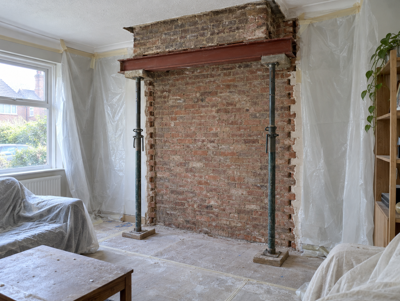
When part of a chimney breast is removed, whatever stays above must be supported. The usual options are a steel beam bearing onto walls that can take the load, or gallows brackets, which are steel brackets fixed to the wall beneath the breast. Brackets suit only some situations, so the structural engineer proposes the method and building control decides whether it is acceptable.
Why does a chimney breast need support after removal?
A chimney breast is heavy masonry built up from its own foundation, often through every floor and out through the roof as a stack. Take out the lower part and the breast above loses what it stands on. Without properly designed support, the remaining brickwork can drop, crack or pull away from the wall, and in a terrace it may affect your neighbour's breast too.
There are two broad ways to deal with that. One is to remove the breast on every floor and take down the stack, so nothing is left to carry. The other is to keep the upper breast or stack and support it on steel or brackets. Our guide range is £1,500 to £3,000 including VAT for a ground-floor removal with support for the breast above, and £2,500 to £5,000 for removing the breast on both floors with the stack supported or taken down.
How does a steel beam support the breast above?
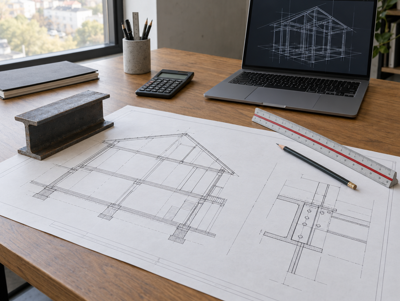
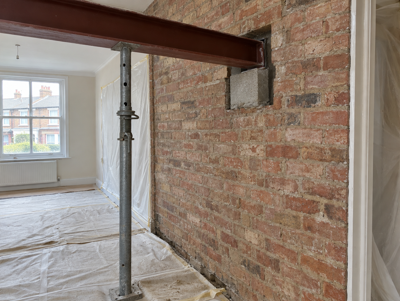
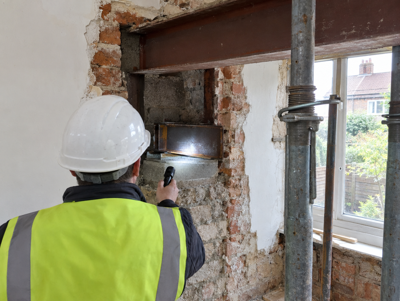
A beam, or sometimes a pair of beams or a short frame, is set beneath the remaining breast and carries its weight across to walls able to take it. Each end needs a sound bearing, which may mean padstones built into the party wall or into the walls either side of the chimney recess. The engineer designs the beam, the bearings and the temporary support needed while the lower brickwork comes out.
A beam is generally the more robust option for heavier loads, because it delivers the weight to solid bearings rather than relying on the face of the wall behind. Trade2Base, a cost guide written for trades, puts steel beam support at £800 to £1,800 supplied, installed and built in, as part of the overall removal price. Once fitted, the beam is fire protected and boxed or plastered like any other steel in the house.
What are gallows brackets and when are they used?
Gallows brackets are steel angle brackets, usually fitted in pairs and fixed into the wall beneath the remaining breast. They work much like shelf brackets: the breast sits on them, and they rely on the wall behind to resist the load. They are quicker to fit and cost less than a beam. Trade2Base gives £400 to £800 for brackets supplied and fitted, and notes they are used only on sound, thick walls approved by the engineer.
That condition is the catch. Where the wall is thin, the brickwork is weak, the breast above is tall or heavy, or the masonry sits against a neighbour's breast, brackets are often not accepted. Approval is decided case by case, so never assume brackets will be acceptable simply because a neighbour or a previous owner used them.
How do a beam and gallows brackets compare?
Both methods aim to carry the remaining masonry safely, but they work differently, and the right choice depends on the loads and on the walls available.
| Steel beam | Gallows brackets | |
|---|---|---|
| How the load is carried | Across to bearings in walls able to take it | Into the wall face directly behind the breast |
| Where it suits | Most situations, including heavier breasts | Lighter loads on sound, thick walls the engineer approves |
| Acceptance | Designed by the engineer and checked by building control | Often not accepted for heavy or shared breasts |
| Cost (Trade2Base, June 2026) | £800 to £1,800 | £400 to £800 |
The cost row shows Trade2Base's June 2026 ranges, which do not say whether VAT is included, and both sit within the overall removal price. Choosing the cheaper method only makes sense once the engineer and building control are satisfied it is suitable for your chimney.
What approvals and notices does chimney breast removal need?
Taking out any part of a chimney breast alters the structure of the house. In England it needs building control approval, and the London Borough of Enfield's 2026/27 charge for removing chimney breasts was £457 including VAT, the same as its load-bearing wall fee. In Scotland a building warrant is needed before work starts, in Wales an application to building control under the Welsh regulations, and in Northern Ireland an application to council building control.
Many chimney breasts are attached to a party wall. The Party Wall etc. Act 1996, which applies in England and Wales, specifically covers cutting away a projecting chimney breast, so a party structure notice must be served at least two months before work starts, and we arrange notices through a party wall surveyor. In Scotland and Northern Ireland there is no such Act; shared walls are governed by the title deeds and the general law instead. Our party wall beam works page has more.
What should I check before removing a chimney breast?
A few practical points affect both the design and the price, so it helps to have answers ready for the survey visit.
- Whether any flue is still used by a fire, stove or boiler, which must be dealt with first
- Whether you want to keep the breast upstairs, in the loft or on the roof
- Whether the stack is shared with a neighbour in a terrace or semi
- How rubble will be removed and floors protected along the route out
- Possible asbestos in old fire surrounds, hearths or flue linings in homes built before 2000
HSE warns that asbestos can be found in any building built before 2000, so a survey of the area to be disturbed comes first in older homes. Ventilating any length of flue that remains helps prevent damp. Our chimney breast removal page explains how the job is carried out.
Last checked 1 November 2026.